| Summary:
Semi trucks have spikes on their wheels mainly because of spike lug nut covers, which are protective caps placed over the lug nuts that hold the wheel to the truck. Despite looking dangerous, they are not weapons and usually are not part of the tire itself. The covers shield lug nuts from rain, dirt, salt, and road debris so they don’t rust or seize, making maintenance easier. The spinning spikes act as a visual warning that discourages drivers from getting too close to a truck’s blind spots. Many drivers customize their rigs, and chrome spikes are a popular cosmetic upgrade. They are generally legal as long as the truck does not exceed the width limits. In short, truck wheel spikes exist mostly for protection and visibility, with style being the bonus. |
If you have ever driven on major highways like I-95 or the Florida Turnpike, you have likely noticed large commercial trucks with chrome colored spikes extending from their wheels. These imposing protrusions often raise questions about their purpose, safety, and legality. Many drivers wonder whether these spikes serve a functional purpose or are purely decorative additions to semi-truck wheels.
The question of why trucks have spikes on their wheels is more common than you might think. Before discussing their purpose, it is important to clarify what these components actually are. The spikes visible on the truck wheels with spikes are not structural parts of the wheel or tire assembly. They are decorative and protective covers known as spike lug nut covers. These covers attach to the lug nuts that secure the wheel to the hub of the truck.
In this guide, we’re breaking down everything you’ve ever wondered about truck wheels with spikes. We’ll talk about why they’re there, if they can actually hurt your car, and what the laws in Florida have to say about them.
What Are the Spikes on Truck Wheels Made Of
Most truck spike lug nuts are made from one of two materials.
- Mostly Plastic: The cheaper and more common type is made of chrome-plated plastic. These are designed to look intimidating but are actually pretty fragile. If something hits them, they’ll shatter or snap off rather than causing serious damage.
- Lightweight Metal: The second type is made of aluminum or stainless steel. These are more expensive, more durable, and often used by owner operators who take great pride in their rigs. You’ll see these on trucks at truck shows or on custom rims for semi trucks that cost thousands of dollars.
So when people ask why truck tires have spikes, the spikes aren’t actually on the tires at all. They’re sitting on the wheel hubs, covering the lug nuts semi trucks use to secure their wheels. It’s more accurate to call them spiked lug nuts on trucks or spike wheel covers.
Three Real Reasons Why Semis Have Spikes on Their Wheels
Despite their aggressive appearance, truck wheels with spikes serve some genuinely practical purposes. Let’s walk through the real reasons truck drivers and fleet owners choose to install these covers.
| Main Reason | What the Spikes Actually Do | How It Helps in Real Life | Extra Notes |
| Protection of lug nuts | Spike lug nut covers act like caps that seal the lug nuts from the outside environment | Keeps out rain, mud, humidity, salt, and debris so the nuts don’t rust or seize | Makes maintenance faster and cheaper because mechanics can remove them easily instead of fighting corrosion |
| Visual safety warning | Creates an intimidating moving visual near the truck wheels | Other drivers instinctively avoid driving too close to the truck, especially in blind spots | Not an official safety device but truckers say it reduces risky lane squeezing and close calls |
| Pride and truck culture | Decorative chrome covers enhance the look of the rig | Drivers personalize their trucks and present a professional image | Very common in truck shows and owner operator culture where the truck is both their workplace and lifestyle |
Are The Spikes Actually Dangerous to Nearby Vehicles?
The Reality: If the spikes are plastic (which they usually are), they will simply snap off or get crushed. You might get a scratch on your paint, but the spike isn’t going to go through your door like a spear.
However, the lug nuts semi trucks use underneath those spikes are a different story. Those are solid steel. If you get close enough to hit the spike, you’re inches away from hitting the actual heavy metal wheel. That is what causes the real damage in a side-swipe accident, not the decorative cap.
Do Truck Wheel Spikes Improve Road Safety?
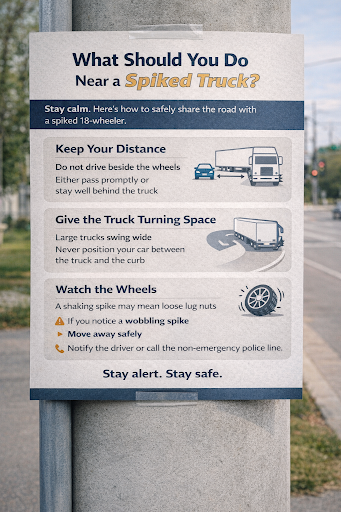
According to the Federal Motor Carrier Safety Administration (FMCSA), large trucks have significant blind spots—areas where the driver cannot see surrounding vehicles even with properly adjusted mirrors. When passenger car drivers see those spikes spinning close to their window, it’s often an instinctive reminder that they’re too close to the truck’s blind zone.
While not an official safety device, many professional drivers report that the visual presence of wheel spikes seems to discourage other motorists from lingering in dangerous positions alongside their trailers.
Are Spiked Lug Nuts Legal? What Florida and Other States Say
One of the most frequently asked questions about truck wheel spikes concerns their legality.
Florida’s Position In Florida, spike lug nut covers are legal as long as the truck doesn’t exceed the maximum width allowed for commercial vehicles. According to Florida Statute 316.515, the maximum vehicle width is typically 102 inches (8.5 feet), including any projections from the vehicle body.
As long as the spikes don’t push the total width past that limit, they’re permitted on Florida roads.
The Important Exception: Law enforcement officers have discretion to cite drivers for unsafe equipment under Florida Statute 316.610 if they determine that wheel spikes are:
- Protruding dangerously far from the wheel hub
- Creating a hazard to other motorists
- Positioned in a way that could scrape vehicles in adjacent lanes
What About Other States? Most states follow similar guidelines, with maximum width restrictions around 102 inches. However, Hawaii stands out with more explicit restrictions through Act 15, which specifically addresses what it terms “dangerous wheels.” States like California and New York don’t have outright bans but enforce strict protruding object laws that can apply to excessively long spike covers.
The Bottom Line
Spikes might be for show, but truck safety is no joke. If you’ve been involved in an accident with a commercial vehicle—spiked wheels or not—the legal team at Truck Wreck Florida understands the complexities of trucking regulations.
Don’t wait for the trucking company’s insurance to call you. They aren’t on your side. Contact us today for a free case evaluation. Let’s talk about your case.
Frequently Asked Questions
Are spiked lug nuts legal in Florida?
Yes, Florida allows spiked lug nuts on trucks as long as the truck’s total width doesn’t exceed 102 inches or 8 and a half feet. However, if a law enforcement officer determines they pose a road hazard, they can issue a citation under general unsafe equipment statutes.
Can semi truck spikes actually pop a car tire?
In most cases, no. Most spike lug nuts for trucks are made of plastic and will shatter on impact before they can puncture a steel belted tire. However, the heavy duty metal lug nuts underneath the decorative covers are what actually cause damage in sideswipe collisions. If your car makes contact with the wheel hub during an accident, those metal components can definitely cause serious damage to your vehicle’s body and wheels.
Do truck wheel spikes cause more damage in an accident?
The spikes themselves are often cosmetic and don’t significantly increase damage in most crashes. However, their presence can be used in court to argue aggressive driving or improper vehicle modification if they exceed legal width limits.
Why do 18 wheelers have spikes on their front wheels but not the back?
The front wheels, called steer axles, are more exposed to road spray, debris, salt, and harsh conditions. Protecting the lug nuts semi trucks use on their steer axles is critical because any failure on those wheels means the driver loses the ability to control the vehicle. The rear wheels are often dual wheels with more protection from fenders and the truck body, so they don’t need as much extra protection.
Are metal spiked lug nuts more dangerous than plastic ones?
Yes, absolutely. While plastic spike covers are common and designed to crumble on impact, some owner operators use solid steel or aluminum truck spike lug nuts. These metal versions do not break away easily and can cause significant gouging, scratching, and denting to passenger vehicles in sideswipe collisions.
What happens if a truck spike falls off on the highway?
A detached metal or hard plastic spike becomes a high-speed projectile that can cause serious accidents. This is a major concern for motorcyclists, who have little protection if they hit a spike bouncing across the road. For cars, a spike can crack windshields, damage undercarriages, or cause drivers to swerve and lose control.
Is Hawaii the only state that bans spiked lug nuts?
Hawaii has the most explicit legislation targeting what it calls dangerous wheels through Act 15. States like California and New York don’t have outright bans, but they have strict protruding object laws that can be used to ticket drivers whose spike rims for trucks extend too far.
Can I sue a trucking company if their wheel spikes scratched my car?
Yes, you can pursue a property damage claim if the spikes protruded beyond legal width limits or were improperly installed. Document the damage with photos, get a police report, and consult with an attorney who specializes in truck accidents to evaluate your case.