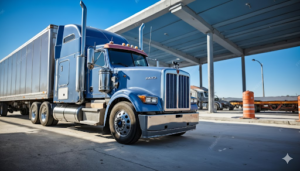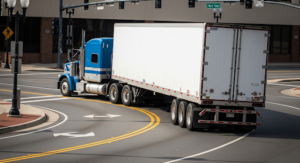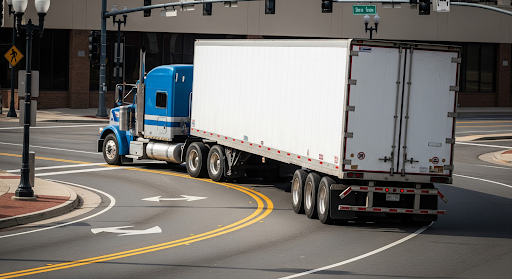
Off-tracking in a large truck happens when the rear wheels and trailer follow a tighter, shorter path than the front wheels during a turn. The result is a trailer that can cut the corner, swing wide, or drift outward on faster curves, creating a high risk of sideswipes, curb strikes, and intersection crashes.
What You’ll Learn in This Blog
|
Truck crashes in Florida don’t happen randomly.
According to the Federal Motor Carrier Safety Administration (FMCSA), 5,936 people were killed in large-truck crashes nationwide in 2022. Roughly 70% of those killed were occupants of other vehicles, not the truck. Intersection conflicts, turning movements, and lane encroachments are recurring patterns in multi-vehicle truck crashes documented in federal crash summaries.
That context matters when we talk about off-tracking.
Because many serious truck crashes begin with a turn that did not leave enough space.
Most people never think about off-tracking until a trailer is already moving into their lane. And by then, there’s very little time or space to fix a bad position.
Off-tracking is not about “bad luck.” It is about how trucks turn, and how quickly a normal turn becomes a dangerous one when the driver misjudges space, speed, or setup.
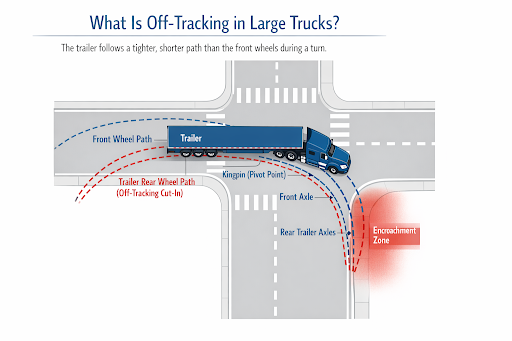
Why Off-Tracking Happens In Large Trucks
Trucks don’t react like cars.
They have a pivot point, long wheelbases, and trailers that move differently from the front axle. That difference is the root of most off-tracking crashes.
Vehicle Length, Trailer Geometry, And The Kingpin Pivot
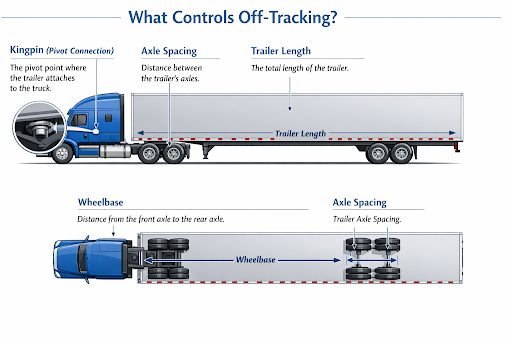
The longer the truck, the more off-tracking you get.
That’s because the trailer is attached at a pivot point, and the rear axles do not trace the same arc as the front wheels.
Mini-Explainer: What Controls Off-Tracking
|
If you’re asking, “What is CDL off-tracking?” — this is what CDL drivers are trained to anticipate on every tight turn.
Low-Speed Off-Tracking At Intersections (Corner-Cutting)
This is the off-tracking most Florida drivers see.
At low speeds, the trailer’s rear wheels track inside the path of the front wheels. That means the trailer can cut the corner even when the tractor looks like it cleared.
This is what off-tracking causes:
- curb and crosswalk encroachment
- lane intrusion during right turns
- impacts with vehicles stopped too close to the corner
Florida reality: dangerous highways, tight intersections, shopping center exits, older downtown streets, and construction lane shifts make low-speed off-tracking worse.
High-Speed Off-Tracking On Curves And Highway Ramps
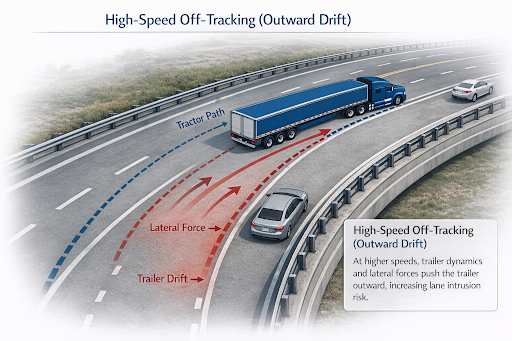
Off-tracking isn’t only a slow-speed problem.
On faster curves, trailer dynamics and lateral forces can push the trailer outward. That outward movement can pull the trailer closer to adjacent lanes or barriers.
Where Florida drivers feel this most:
- ramp curves and merges on I-4, I-75, and I-95
- heavy freight corridors with stop-and-go lane pressure
- wet pavement where traction drops and trailer movement gets less predictable
Driver Miscalculation And Inadequate Cdl Training
Off-tracking is predictable.
But predicting it in real traffic takes training and discipline.
Common driver failures include:
- turning too early or too late (bad setup)
- using the wrong lane position before the turn
- not checking mirrors through the full turn
- making sudden corrections mid-turn
People also search “off-tracking or cheating CDL.” Online, that phrase is often used loosely to describe corner-cutting habits.
In crash analysis, off-tracking is the wheel-path difference caused by geometry. The legal question is whether the driver managed that predictable movement safely.
The Dangers Of Off-Tracking For Florida Drivers
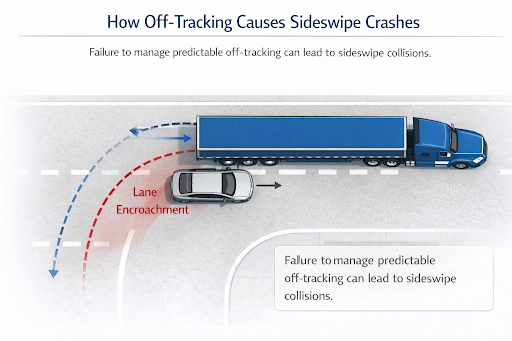
Off-tracking crashes happen where space is tight.
Intersections. Ramps. Work zones. Tourist corridors. Downtown grids.
And when a 40,000 – 80,000-pound vehicle needs more room than the road gives it, small mistakes become severe injuries.
Sideswipe Collisions In Adjacent Lanes
This is the most common off-tracking crash outcome.
A trailer swings wide or cuts in and sideswipes:
- a vehicle beside it
- a driver passing at the wrong moment
- a car sitting in the trailer’s blind area
Pedestrian And Cyclist Crush Risks At Intersections
Low-speed off-tracking is especially dangerous near curbs.
If the trailer rear wheels track inward, they can encroach into:
- crosswalk edges
- curb lines
- bike lanes
Florida hotspots include tourist zones, downtown intersections, and construction areas with narrowed sidewalks.
Fixed Object And Parked Vehicle Collisions
Off-tracking doesn’t just hit moving cars.
It commonly causes impacts with:
- poles and traffic signals
- parked vehicles
- medians, curbs, and corner infrastructure
These impacts often leave physical evidence — scrape lines, tire marks, broken hardware — that matters later.
Rollovers Caused By Overcorrection
When a driver realizes the trailer is tracking wrong, a sharp correction can trigger a rollover.
Rollover risk increases when:
- The turn is too fast
- The load shifts
- The driver steers aggressively to “save” the turn
Takeaway: Off-tracking is dangerous. Overcorrecting is worse.
How Truck Drivers Are Trained To Prevent Off-Tracking (CDL Standards)
CDL drivers are taught that off-tracking is normal.
What is not normal is failing to manage it.
Wide-Turn Techniques And Lane Positioning
A safe wide turn is a controlled setup.
It involves:
- choosing the correct lane position early
- signaling early and clearly
- using swing room to protect the trailer path (not drifting)
- controlling speed so the trailer stays predictable
“What is the 7 3 rule in trucking?” This phrase is commonly mixed into unrelated CDL discussions (often backing or training shorthand).
It is not the definition of off-tracking.
Off-tracking refers to the rear wheels and trailer following a different path than the front wheels during a turn.
Speed Reduction And Mirror Monitoring
Two habits prevent most off-tracking crashes:
- Reduce speed before the turn so the trailer stays stable and predictable
- Track the trailer in the mirrors from start to finish
A turn is not safe because it started correctly. It is safe only if the trailer clears through the entire path.
Hours-Of-Service And Fatigue Compliance
Fatigue causes bad turns.
It leads to:
- late decisions
- missed mirror checks
- poor spacing judgment
- sloppy setup at intersections
That is why Hours-of-Service rules exist — including the 14-hour on-duty window and the 60/70-hour limits under 49 CFR §395.3.
These federal regulations are designed to reduce fatigue-related errors, including delayed reactions and poor turn setup decisions.
How Florida Drivers Can Protect Themselves From Off-Tracking Crashes
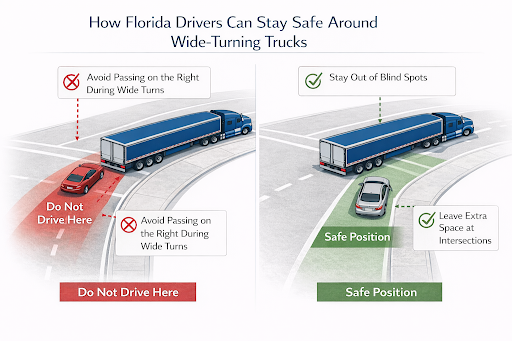
You can’t control how a truck turns. But you can control whether you put your vehicle in the danger zone and prevent crashes.
Stay Out of Blind Spots During Turns
If you’re beside a trailer during a turn, you may be invisible.
Practical rule: if you can’t clearly see the truck’s mirrors and driver position, assume the driver may not see you.
Never Pass on the Right During a Wide Turn
One of the most common wide-turn collisions happens when a driver tries to “sneak by” on the right.
If a truck swings left to set up, it may still be turning right.
Do not take the gap. That gap closes.
Leave Extra Space at Intersections and Exit Ramps
Off-tracking is a space problem.
It becomes a crash problem when drivers crowd the corner.
Give extra space in:
- intersections
- tight commercial entrances
- exit ramps where lanes compress
Florida roads where this happens constantly:
- I-75 exits during commuter surges
- US-41 corridor traffic and signals
- I-4 congestion and short merges
When Off-Tracking Leads to a Truck Accident in Florida
Off-tracking crashes are rarely “simple.”
They involve commercial standards, professional training expectations, and evidence that can disappear fast.
Determining Fault in an Off-Tracking Collision
Florida is an at-fault state under pure comparative negligence (Florida Statute §768.81).
That means fault can be shared, and the percentage directly affects financial recovery.
In off-tracking cases, investigators look at:
- lane position and turn setup
- signaling and timing
- speed entering the turn or curve
- mirror usage and trailer tracking
- whether the truck encroached into another lane or crosswalk
Evidence That Proves Off-Tracking Negligence
Evidence wins these cases.
And in commercial vehicle cases, evidence is often technical and time-sensitive.
And evidence disappears.
Important evidence often includes:
- photos/video of the trailer angle, lane lines, curb strikes
- police reports and witness statements
- ELD data and driver logs
- maintenance and inspection records
- dashcam, traffic cam, nearby business footage
- crash reconstruction (turn path + wheel tracking analysis)
Why Off-Tracking Cases Are Legally Complex
These cases can involve multiple responsible parties.
Depending on the facts, liability may include:
- the truck driver
- the trucking company (training, supervision, scheduling)
- freight brokers or shippers (pressure and timelines)
- maintenance contractors
- equipment issues affecting handling
That is why off-tracking claims are not “one-call” insurance conversations.
Injured in an Off-Tracking Truck Accident in Florida?
If you were hit during a truck turn — especially a wide right turn, ramp curve, or intersection maneuver — treat it as a serious crash.
What to do immediately:
- Seek medical care and document symptoms early.
- Photograph vehicle positions, lane markings, curb strikes, and trailer angles.
- Get witness information before people leave.
- Avoid recorded statements until you understand what is being asked.
- Speak with a Florida truck accident lawyer before the evidence disappears.
Truck Wreck Florida has decades of experience investigating serious truck crashes across Florida.
Our firm has represented injured victims for more than 35 years and understands how truck geometry, CDL standards, and federal safety regulations intersect in real crash investigations.
Call us now for a free consultation or visit our website for more information!
In Summary: What Off-Tracking Really Means
Off-tracking is the predictable difference between where a truck’s front wheels travel and where its trailer ultimately follows.
At low speeds, the trailer cuts inward. At higher speeds, it can drift outward.
When that movement is misjudged or poorly managed, it leads to lane intrusions, curb-line impacts, sideswipe collisions, and rollover risks.
Understanding that geometry is the first step. Managing it safely is the responsibility of the professional driver.
FAQ: Off-Tracking in Large Trucks
What is off-tracking in trucks?
Off-tracking is when a truck turns, and the rear wheels follow a different path than the front wheels. In tight, low-speed turns, the trailer usually cuts inward (corner-cutting). In faster curves, the trailer can drift outward. Both create a high risk of sideswipes and curb-line impacts.
What is off-tracking CDL?
In CDL terms, off-tracking is the predictable trailer cut-in (and sometimes outward drift) that drivers must manage using proper setup, speed control, and mirror monitoring so the trailer clears lanes, curbs, and crosswalk areas.
What are the things that affect off-tracking?
The main factors are trailer length, axle spacing, kingpin pivot geometry, turn radius, speed, load stability, and driver technique (setup position, signals, and mirror tracking).
What happens if tracking is off?
When tracking is off, the trailer can cut the corner, swing into an adjacent lane, strike curbs or crosswalk edges, hit fixed objects, or sideswipe vehicles — especially at intersections and exit ramps.
What can bad tracking cause?
Bad tracking can cause sideswipe crashes, pedestrian/cyclist impacts near curb lines, collisions with poles or parked cars, and rollovers if the driver overcorrects or the load shifts.
What is off-tracking or cheating in CDL?
Online, people sometimes use “off-tracking” to describe sloppy corner-cutting habits. In safety terms, off-tracking is the wheel-path difference caused by geometry. “Cheating” is slang that can mean taking unsafe shortcuts in maneuvers, separate from the physics definition.
What is the 70-hour rule for truckers?
The 70-hour rule is part of the Hours-of-Service limits that restrict total on-duty hours in a set period to reduce fatigue. Fatigue directly affects judgment and spacing decisions, which is why it often shows up in turn and ramp crashes.
Disclaimer: This blog is for informational purposes only and does not create an attorney-client relationship. For legal advice, consult a qualified Florida truck accident attorney.