Summary
|
In 2024, trucks accounted for roughly 72.7% of freight by weight. There are over 3.5 million professional drivers in the USA, playing a pivotal role in keeping the national economy moving while operating under extreme physical, financial, and environmental stress. A fully loaded Class 8 vehicle can weigh up to 80,000 lbs.
The margin of error is zero for professional drivers, who bear a heavy and disproportionate responsibility for the safety of everyone on the road. The following 9 safety messages provide direct, life-saving mandates to help ensure every driver makes it home safely.
1. Clear the No-Zones
According to the Federal Motor Carrier Safety Administration (FMCSA):
“No-Zones are the danger areas around a truck where crashes are most likely to occur because the driver’s vision is limited or completely obstructed.”
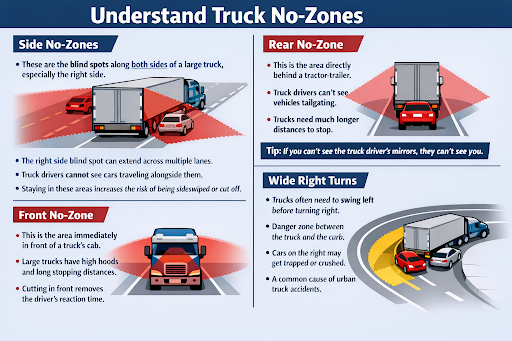
Due to its size, a tractor-trailer has the following four massive zones of invisibility:
- Side no-zones
- Rear no-zone
- Front no-zone
- Wide right turns
Professional Countermeasures
The FMCSA and National Highway Traffic Safety Administration (NHTSA) recommend the following measures to mitigate no-zone risks:
- Check your mirrors every 5 to 8 seconds to “track” vehicles as they enter and exit your No-Zones.
- Use the 10-second signal rule before changing lanes. Engage your turn signal for a minimum of 3 seconds before beginning the move, and take 7 seconds to complete the lane change.
- Minimize the number of lane changes required by staying in the right-hand lane or the “lane of least resistance.”
2. Manage Fatigue
Fatigue is the result of physical or mental exertion that leads to slower reaction times, reduced attention, and impaired judgment. According to studies, being awake for 17 to 19 hours is comparable to a BAC (Blood Alcohol Concentration) of 0.05%.
| According to § 383.5, the legal BAC limit for a Commercial Driver’s License (CDL) holder is 0.04%. |
Stop immediately if you notice the following:
- Operational errors, such as struggling to maintain a constant speed
- Cognitive lapses, such as missing your exit
- Brief, involuntary episodes of sleep lasting 3 to 5 seconds
Preventing Fatigue
| Regulation | Requirement |
| 11-Hour Driving Limit | Max 11 hours driving after 10 hours off duty |
| 14-Hour Limit | Max 14 hours on duty (includes non-driving work) |
| 30-Minute Break | Required after 8 cumulative hours of driving |
Table 1: Federal Hours of Service (HOS) Mandates, 49 CFR Part 395
Professional Countermeasures
| Strategy | Recommendation |
| Sleep | 7 to 9 hours |
| Napping | 10 to 45 minutes if feeling drowsy |
| Circadian Awareness | Extra vigilance during 12 a.m. – 6 a.m. and 2 p.m. – 4 p.m. |
Table 2: Strategies to Manage Fatigue
3. Maintain Following Distance
Maintaining an adequate following distance is the most effective way to prevent rear-end collisions. The total stopping distance of a fully loaded tractor-trailer weighing 80,000 lbs depends on the four factors shown in the table below:
| Factor | Description | Average Duration/Time |
| Perception Distance | The distance traveled from the moment a hazard appears until the driver recognizes it | 1.5 seconds |
| Reaction Distance | The distance traveled while the driver moves their foot from the accelerator to the brake pedal | 0.75 to 1.5 seconds |
| Brake Lag Distance | The time required for air to flow through the lines to the brake chambers | Approx. 0.5 seconds |
| Braking Distance | The physical distance the truck travels while the brakes are being fully applied | Varies by speed and weight |
Table 3: Factors affecting stopping distance
A loaded CMV (commercial vehicle) traveling at 65 mph covers approximately 525 feet to come to a complete halt after applying the brakes.
Maintaining a Safe Following Distance
The table below shows the FMCSA recommendations for maintaining a safe following distance:
| Vehicle Speed | Formula | Total Following Distance |
| Under 40 mph | 1 second for every 10 feet of vehicle length | 6 Seconds |
| Over 40 mph | 1 second for every 10 feet + 1 second safety buffer | 7 Seconds |
Table 4: FMCSA recommendations for a safe following distance
4. Adjust Speed for Weather
One of the key truck driver safety tips is exercising “extreme caution” in hazardous conditions such as rain, snow, ice, or fog. It is important to maintain the right speed to maintain control of the vehicle.
| Road Condition | Required Speed Reduction | Objective |
| Wet | Reduce speed by at least 1/3 |
|
| Packed Snow | Reduce speed by 1/2 or more |
|
| Ice/Black Ice | Reduce to a crawl or stop |
|
Table 5: Managing speed according to road condition
A water layer between the road surface and the tires can cause hydroplaning, which can lead to the truck losing steering and braking control.
High Wind
The center of gravity is high in empty trailers, making them vulnerable to “blow-overs.” Reduce speed or seek shelter after wind gusts exceed 40–50 mph. The extra weight acts as an anchor in a fully-loaded trailer, reducing the risk.
The following table shows general guidelines by most carriers and safety organizations:
| Wind Speed/Gusts | Risk Level | Recommendations |
| 25–30 mph | High alert |
|
| 40 mph | Critical threshold |
|
| 60+ mph | Extreme Danger |
|
Table 6: Safety recommendations for windy conditions
Limited Visibility
Your primary defense in fog, heavy rain, or blowing snow should be “seeing and being seen.”
| Condition | Hazard | Professional Protocol |
| Fog/Mist |
|
|
| Heavy Rain |
|
|
| Blowing Snow |
|
|
Table 7: Safety in limited visibility
5. Perform Rigorous Pre-Trip Inspections
According to 49 CFR § 396.13, the driver must be satisfied that the truck is in a safe operating condition. Inspections reveal brake fade and other mechanical failures that can cause accidents.
The following table shows the mandatory 11-point checklist for the Daily Vehicle Inspection Report (DVIR) by 49 CFR § 396.11:
| Inspection Item | What to Look For |
| Service Brakes |
|
| Parking Brake |
|
| Steering Mechanism |
|
| Lighting & Reflectors |
|
| Tires |
|
| Horn |
|
| Windshield Wipers |
|
| Rear-Vision Mirrors |
|
| Coupling Devices |
|
| Wheels and Rims |
|
| Emergency Equipment |
|
Table 8: 11-point checklist for DVIR
6. Eliminate In-Cab Distractions
Distracted driving is a leading cause of truck accidents. The table below shows common in-cab habits that can significantly increase the risk of collision:
| Distraction | Risk Factor | Professional Protocol |
| Mobile Devices | 6x more likely to crash |
|
| Eating/Drinking | Diverts focus and one hand |
|
| GPS/Dispatch | Manual data entry while moving |
|
| Loose Objects | Items falling on the floorboard |
|
Table 9: Common In-Cab Distractions
7. Control Turn Speeds
CMVs are subject to centrifugal force due to their high center of gravity. This force can pull a trailer over even when the tractor feels stable. A truck driver should strictly follow the speed guidelines in the table below:
| Location | Recommended Speed | Safety Objective |
| Off-ramps/on-ramps | 5–10 mph BELOW posted speed |
|
| Sharp Curves | 5–10 mph BELOW posted speed |
|
| Intersections | Crawl speed (under 15 mph) |
|
Table 10: Turn speed guidelines
The Slow-In, Smooth-Out Principle
Brake Before, Not During
Apply the brake while the truck is still moving in a straight line. Do not apply the brakes in a curve, as it can lock the wheels and cause a jackknife.
The “Low Gear” Rule
When it comes to very sharp turns or steep descending ramps, always shift to a lower gear before you enter the turn. This helps maintain a steady, slow speed.
Watch Your Off-Tracking
Off-tracking occurs when the rear wheels follow a shorter path than the front wheels. You have time to monitor your trailer tires in the mirror when you keep your speed low.
| Loaded trailers are 10 times more likely to roll over. |
8. Use Engine Braking on Declines
Gravity can push a fully loaded 80,000-pound vehicle to uncontrollable speeds on long, steep downgrades. You cannot solely rely on your service brakes. Use a compression release engine brake to control speed.
| Phase | Action |
| At the crest | Slow down and downshift before you start the descent. |
| Gear | Use the same gear. |
| During descent | Use the 3-position Jake Brake switch to manage speed. |
Table 11: Descent Protocol
Operating on a Slippery SurfaceDo not use an engine brake on wet, icy, or snow-covered roads, as it can cause the drive wheels to lock up and lose traction. |
9. Park Safely
You need to ensure visibility of other drivers and prevent roll-aways while parking. In the case of an emergency, pull over on a highway shoulder. According to federal laws, you must take action within 10 minutes to alert oncoming traffic.
Hazard Lights
Activate immediately upon stopping and keep them on until you place triangles.
Warning Triangles
Use 3 bidirectional reflective triangles and place them within 10 minutes.
| Road | Placement |
| 2-lane |
|
| Divided |
|
Table 12: Reflective Triangle Placement
Preventing Rollaways
Follow the Set, Test, and Block method to prevent roll-aways.
Set: Pull both the yellow (tractor) and red (trailer) valves.
Test: Gently put the truck in gear and try to pull forward. This helps ensure that the trailer brakes are holding.
Block: Place wheel chocks firmly against the tires.
Conclusion
These safety messages for drivers are more than just truck driver safety tips. Truck Wreck Florida has shared the guidelines issued by FMCSA and other bodies.
We have been committed for 35+ years to advocating for trucking injury victims.
Contact us for a free consultation today!
Frequently Asked Questions
What is the “10-Second Rule” for lane changes, and why is it necessary?
The 10-second rule gives vehicles in your “No-Zones” time to react or move. Signal for 3 seconds, then take 7 seconds to complete the lane change.
What should I do if my brakes start to smoke or fade on a steep grade?
Slow down immediately and downshift. Use engine braking if conditions are dry. Stop in a safe area and allow brakes to cool. Inspect them before you continue.
How does a “High Center of Gravity” affect my speed on off-ramps?
Centrifugal force pulls the top of your trailer outward during a turn due to a high center of gravity.
Why should I avoid using engine brakes on wet or icy roads?
It’s because applying engine brakes can cause the drive wheels to lock on slippery surfaces, leading to a loss of traction or a skid.