Summary:
|
Florida was the sixth-largest exporter of goods in 2024, achieving a value of $72.2 billion. From raw materials to consumer goods, trucks move over 80% of freight in the state, making a significant contribution to the Florida economy.
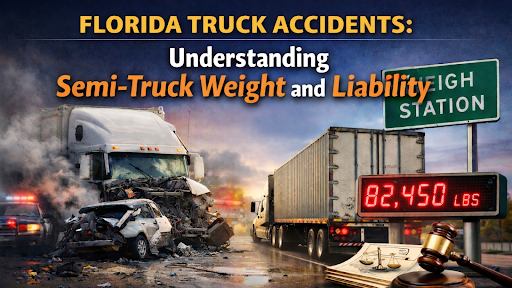
While commercial vehicles such as semi-trucks account for only a small percentage of road accidents, truck collisions often result in more severe injuries or fatalities due to their size and weight. This is why it is highly regulated by federal and state governments. The weight of a semi-truck is a key legal factor in truck collision cases that should not be overlooked. This article explores how semi-truck weight impacts accident severity and liability.
Why Semi-Truck Weight Matters in Accidents
Federal rules limit the weight of a fully loaded semi-truck to 80,000 pounds gross vehicle weight, which includes the truck, trailer, and cargo. This is more than 20 times the weight of a passenger vehicle.
The following are the dangers of an overweight truck:
- Longer braking distances
- Increased risk of rollovers
- Tire blowouts
- Brake failure
- Reduced steering control
- Greater crash force and injury severity
How much does a truck weigh is more than a safety issue. It is a legal issue.
Federal and Florida Semi-Truck Weight Laws
Exceeding limits can create serious safety hazards. That is why semi-trucks are strictly regulated at both the federal and state levels.
The Federal Motor Carrier Safety Administration (FMCSA) sets nationwide weight limits as shown in the table below:
| Type | Limit |
| Maximum Gross Vehicle Weight (GVW) | 80,000 lbs |
| Single Axle Weight | 20,000 lbs |
| Tandem Axle Weight | 34,000 lbs |
Bridge Formula
The bridge formula is a federal regulation that protects bridges by controlling how much weight is concentrated over short spans.
Formula:
W=500[(LN)/(N-1)+12N+36]
W: Weight
L: Axle distance in feet
N: Number of axles in a group
Violations of these regulations are considered evidence of negligence in accident claims.
Florida also provides special permits for overweight trucks but with route and other conditions.
Weight-Related Violations in Truck Accidents
Semi-truck weight-related violations often contribute to truck accidents. When trucking companies fail to comply with these regulations, the risk of mechanical failure, loss of control, and catastrophic collisions increases significantly. The most common violations include:
- Overloaded gross vehicle weight
- Axle weight violations
- Improperly loaded or unbalanced cargo
- Failure to secure cargo
- Exceeding permit limits
- Inaccurate or falsified weight documentation
- Skipping required weigh stations
How Truck Weight Impacts Liability in Florida
Weight Violations as Proof of Negligence
Florida follows a fault-based system for personal injury claims. FMCSA regulations and Florida Statutes §316.535 set the maximum legal weights for vehicles. A violation can be used as evidence of a breach of duty of care. It can also support a claim of negligence per se.
Effect on Accident Causation
Overweight semi-trucks often require a longer stopping distance. Excessive weight also reduces maneuverability and places excessive stress on braking and steering systems.
| Accident | Cause |
| Rear-end collisions | Delayed braking |
| Rollover accidents | Reduced stability |
| Loss of control | Limited maneuverability |
| Mechanical failures | Brake overheating or tire blowouts |
Impact on Comparative Fault Arguments
Florida’s modified comparative negligence rule allows parties to share fault. However, it is difficult for the defense to shift blame if there is clear evidence of an overweight or improperly loaded truck. Violations of weight regulations are preventable failures.
Violations of Special Permit
Overweight trucks can operate in Florida with special permits, subject to strict route and weight restrictions. Violations of permit requirements often increase liability and weaken defenses.
Increased Damages
An overloaded truck often crashes with greater force, which can also cause long-term disability, increasing medical costs. This can also lead to punitive damages under Florida law.
Parties That May Be Liable in Weight-Related Truck Accidents
| Party | Violation |
| Truck Driver |
|
| Trucking Company |
|
| Cargo Loaders/Shipping Companies |
|
| Freight Brokers/Logistics Companies |
|
| Maintenance or Inspection Providers |
|
| Vehicle or Equipment Manufacturers |
|
| Government or Permit-Issuing Authorities |
|
Evidence Used to Prove Overweight or Improperly Loaded Trucks
The following key types of evidence are used to prove weight violations:
- Weigh station records and scale tickets
- Bills of lading and shipping documents revealing cargo type, quantity, and weight
- ELD and onboard data records
- Cargo inspection reports and photographs documenting unsecured, shifted, or unbalanced loads
- Crash scene photos and video footage showing spilled cargo or trailer instability
- Weight-related brake or tire failures
- Police reports and citations noting weight or permit violations
Injuries Commonly Caused by Overweight Semi-Truck Accidents
Overweight semi-truck collisions often lead to severe injuries that can be life-altering. The following table shows the common injuries caused by weight-related truck accidents:
| Type of Injury | Cause |
| Traumatic Brain Injuries (TBIs) | Violent head impacts during collisions |
| Spinal Cord Injuries and Paralysis | Crushing forces in heavy truck accidents |
| Broken Bones and Complex Fractures | High-impact force |
| Internal Organ Damage | Severe impact or compression inside the body |
| Severe Back and Neck Injuries | Force of impact |
| Crush Injuries | Smaller vehicles pinned or underride a truck or trailer |
| Burn Injuries | Fuel spills or fires after a collision |
Severe overweight truck accidents can also lead to wrongful death.
What Accident Victims Should Do After a Florida Truck Crash
It is important to take the right steps after a truck accident to protect your health, preserve evidence, and support any potential legal claim. The victim should take the following actions:
- Move to a safe location and call 911 immediately
- Get medical attention
- Keep detailed medical records
- File a police report
- Document the scene
- Record witness names, contact information, and statements
- Preserve dashcams, surveillance camera or traffic camera videos
- Keep all documents (bills of lading, delivery documents, shipping records, repair estimates, invoices, vehicle inspection reports, etc.).
- Notify your insurance company
- Consult a truck accident lawyer
Conclusion
It is the knowledge and experience of a truck accident lawyer that makes the real difference in truck collision cases. Insurance companies fight hard to ensure that they pay the absolute minimum. These questions will help you get the best legal representation.
Truck Wreck Florida is a dedicated practice of Berke Law Firm, P.A., with more than 35 years of experience.
Get a free case evaluation today!
Frequently Asked Questions
How much does a truck accident lawyer cost?
Most truck accident lawyers in Florida work on a contingency basis. You don’t have to pay anything up front. The lawyer’s fee is a percentage of the compensation they recover for you.
What are other fees involved in a lawsuit?
Other case-related expenses include court filing fees, accident reconstruction costs, expert witness fees, medical record retrieval, and deposition expenses.
Is there a deadline for filing a trucking accident lawsuit?
You have two years from the date of the accident to file a personal injury lawsuit. You cannot recover compensation if you miss the deadline.
Why not just accept the insurance settlement?
It’s because the early settlement offers are far lower than the true value of your claim. These offers often do not cover future medical care, lost earning capacity, or long-term pain and suffering.
How long does a truck accident lawsuit take?
It depends on the complexity of the case, the severity of injuries, and whether you settle or go to trial. The case may take from a few months to a year or more.