Summary
|
Involved in a truck accident? Hiring the right truck accident attorney makes a huge difference in the outcome of your case. Truck accidents are much more complex than car accidents. Not only are there multiple potential liable parties and insurance companies fighting aggressively to minimize payouts, but state and federal regulations also affect your case.
You need a lawyer with the experience, knowledge, and strategy required to handle the unique challenges of such cases.
The initial consultation is the time to ask key questions to understand how the lawyer handles cases, communicates, and what their plan is to secure the compensation you deserve.
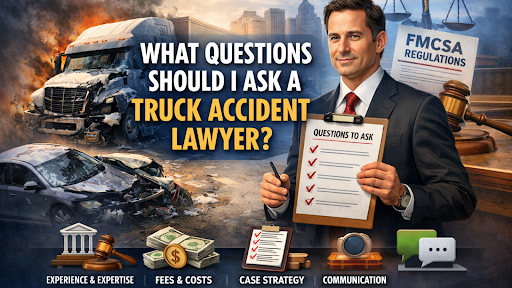
Let’s see what to ask a truck accident lawyer.
Experience and Expertise
How many truck accident cases have you handled?
Experience matters because of the complexities involved in truck accident cases. There can be multiple liable parties, including the truck driver, the trucking company, manufacturers, and even maintenance companies. Insurance companies have a team of highly experienced lawyers who fight tooth and nail to minimize, and even avoid, payouts.
Truck accident cases often require collecting logs, maintenance records, black box data, driver schedules, and other important pieces of evidence. You need a lawyer who has a thorough understanding of state and federal laws.
How many of those went to trial vs. settlement?
Not all truck accident cases should settle out of court. This question helps you understand whether the lawyer is prepared to take the case to court. Good truck accident lawyers do not mainly push for quick settlements. When there is a genuine risk of losing the case in court, insurance companies often offer better settlements when you hire a lawyer with real trial experience. You need a lawyer who can handle settlements and is also fully prepared to go to trial to recover fair compensation.
Are you familiar with federal trucking regulations (FMCSA)?
The Federal Motor Carrier Safety Administration (FMCSA) sets strict regulations that play a major role in truck accident cases. These regulations govern how commercial trucking companies operate, including HOS (hours-of-service) limits, driver qualifications, vehicle maintenance, cargo loading, and drug and alcohol testing. To identify violations that constitute strong evidence of negligence, the lawyer must be familiar with FMCSA regulations. Strong evidence helps pursue maximum compensation.
Have you handled cases involving the same trucking company or accident type?
It is good to have a lawyer with experience in situations similar to yours. Truck accident cases depend on the trucking company and type of accident, such as rear-end collisions, jackknife accidents, rollovers, or multi-vehicle crashes. A lawyer who has fought against the same trucking company in the past is familiar with their safety history, insurance providers, and legal strategies. Similarly, experience with the same type of accident means the lawyer knows the required evidence, the experts to involve, and the strategies the company uses to counter.
Will you personally handle my case, or delegate it to a team member?
Ask this question to set clear expectations. Often, senior attorneys handle initial consultations, while associates or paralegals handle much of the day-to-day work. While it is good to have a team handling your case, it is important to know who is responsible for creating the case strategy, negotiating with insurance companies, and representing you in court. The answer to this question ensures accountability and makes you feel confident that an experienced lawyer is giving the attention required in your case.
What is your success rate with truck accident claims?
What is the track record of the truck accident lawyer with truck accident cases? A strong history of successful claims indicates experience, effective strategy, and the ability to handle unique challenges in such cases. See the outcomes of cases, including fair settlements and favorable verdicts.
Case Handling and Communication
How often will I receive updates about my case?
You need clear and consistent communication to receive regular updates. It can take months, or even longer, to resolve truck accident cases. A good lawyer keeps you informed throughout the process. This helps avoid misunderstanding and gives you peace of mind.
Who will be my main point of contact?
If you have any questions, concerns, or need to get updates on your case, you need a main point of contact. In many law firms, the point of contact is a paralegal or case manager. Having a point of contact helps avoid confusion and maintain a clear line of communication.
How will you involve me in key decisions?
The following are the key decisions that require your involvement:
- Accepting or rejecting a settlement offer
- Filing a lawsuit
- Taking the case to trial or continuing negotiation
- Identifying a party to hold liable
- Types of damages to pursue
- Handling insurance communications
- Accepting or rejecting mediation
- Exploring other options to resolve the dispute
What is your preferred method of communication?
Having a preferred method of communication helps you avoid delays and frustrations. Some lawyers prefer phone calls while others use email, client portals, and text messages. You want a quick response from your lawyer. Establish a reliable medium of communication.
Will I get written progress reports, and how frequently?
Your lawyer should keep you informed beyond phone calls or emails. A written progress report provides you with a clear record of what has been done, upcoming deadlines, and important developments.
Some law firms provide written weekly, biweekly, or monthly updates. Other firms send written updates after major developments.
Fees and Costs
Do you work on a contingency fee basis?
When a firm works on a contingency fee basis, you don’t need to pay any upfront fee. You have to pay a percentage of the settlement or verdict only after winning the case. Other firms charge for their services. Knowing this upfront helps you avoid surprises.
Are there additional costs I should know about?
In addition to the lawyer’s fee, there are some additional expenses, including:
- Court filing fees
- Expert witness fees
- Medical record retrieval
- Accident reconstruction
- Investigation costs
Some lawyers cover these costs upfront, while others deduct them from your settlement. The answer to this question provides you with the full financial picture.
What happens if my case goes to trial?
When the case goes to trial, you need to learn about:
- Timeline changes
- Additional costs
- Lawyer’s strategy
You need to understand the trial process and prepare for all possible outcomes.
Case Strategy and Outcome
What types of damages can I recover?
Depending on the severity of the accident, a truck accident victim may be entitled to different types of compensation, including:
- Medical expenses to cover hospital stays, surgeries, medications, rehabilitation, and ongoing care
- Lost wages due to injury
- Physical pain, emotional distress, or reduced quality of life
- Property damage
- Wrongful death damage
The lawyer should be able to develop a strategy to maximize your compensation.
What challenges do you foresee in my case?
The lawyer should have a realistic plan to overcome the following challenges:
- Disputed fault and comparative negligence
- Multiple liable parties
- Preserving evidence such as electronic logging device (ELD) data, black box information, maintenance records, and driver logs
- Disputes related to federal and state regulations
- Defense tactics of aggressive insurance companies
- Insurers disputing the cause of the injury
How long do you expect my case to take?
The timeline depends on factors including:
- Severity of injuries
- Number of liable parties
- Complexity of the investigation
- Settlement or trial
This question helps set realistic expectations. The lawyer should be able to explain the key stages of the trial and how long each stage will take.
Will my case likely go to trial?
A good lawyer evaluates the risk, leverage, and settlement value of the case. Cases go to trial mostly because of the following reasons:
- Liability is disputed.
- Damages are significant.
- Insurance companies refuse to offer fair compensation.
If negotiations fail, your lawyer should be prepared to litigate.
What is your approach to negotiating with insurance companies?
Your lawyer needs to build leverage before starting negotiations. Building that leverage requires:
- Gathering complete medical records
- Documenting long-term damages
- Preserving FMCSA violations
- Identifying all liable parties
- Preparing the case as if it will go to trial
How will you ensure I get full compensation?
Insurance companies try to dispute liability, downplay injuries, or ignore future losses. This question helps you understand whether the lawyer has a concrete plan to secure your compensation. A strong lawyer prepares the case as if it will go to trial.
Conclusion
Securing the compensation you deserve is a challenging process. You need the right lawyer who understands your unique situation and develops a strong case. Truck Wreck Florida is a leading team of truck accident attorneys that serves the best interests of their clients and helps secure the compensation they deserve.